
UV-C Disinfection — Frequently Asked Questions
Safety
Are the UV-C inspection viewports safe to look through? Yes — with the polycarbonate viewport in place, clean and intact. We verified this with a calibrated, class-1 UV-C radiometer (sglux Safester UVC) on a 200 mm polycarbonate viewport, changing only whether the viewport sat in the optical path: Direct UV-C, no viewport: 0.10 mW/cm² biologically-effective — which reaches the Directive 2006/25/EC daily exposure limit (Heff = 30 J/m²) in about 30 seconds. Through the 200 mm viewport: 30.11 nW/cm² — about 99.97% removed (a factor of ~3,300; optical density ≈ 3.5), which would take longer than a full 24-hour day to reach the same limit. In other words, an operator can look through a clean, intact viewport for a whole working day and stay within the occupational exposure limit. Polycarbonate absorbs UV-C within its first fraction of a millimetre while staying transparent to visible light, so you can still see in. Important: these figures are specific to the lamp, geometry and viewport tested — higher-output installs should be re-verified. The viewport protects people looking through a closed unit; it is not a maintenance control. Always isolate and lock out the lamps before opening a unit, and use rated eye and skin protection when working near energised lamps. (Reference AUV-TR-2026-014.) Is UV-C safe for people? Direct UV-C is harmful to unprotected eyes and skin, so our systems are designed to keep it contained — sealed inside ductwork or chambers for in-duct air disinfection, and fitted with shielding, interlocks and controlled access for in-room systems. Exposure is managed through enclosure, viewports, interlocks and lock-out procedures during maintenance. We can help specify the right safeguards for your application. Does UV-C produce ozone? It depends on the lamp. Standard low-pressure UV-C lamps emit mainly 254 nm and are effectively ozone-free; lamps that also emit 185 nm produce ozone by design. Most of the air and surface disinfection lamps we supply are the ozone-free 254 nm type — tell us your application and we’ll confirm which lamp is specified.
How UV-C works
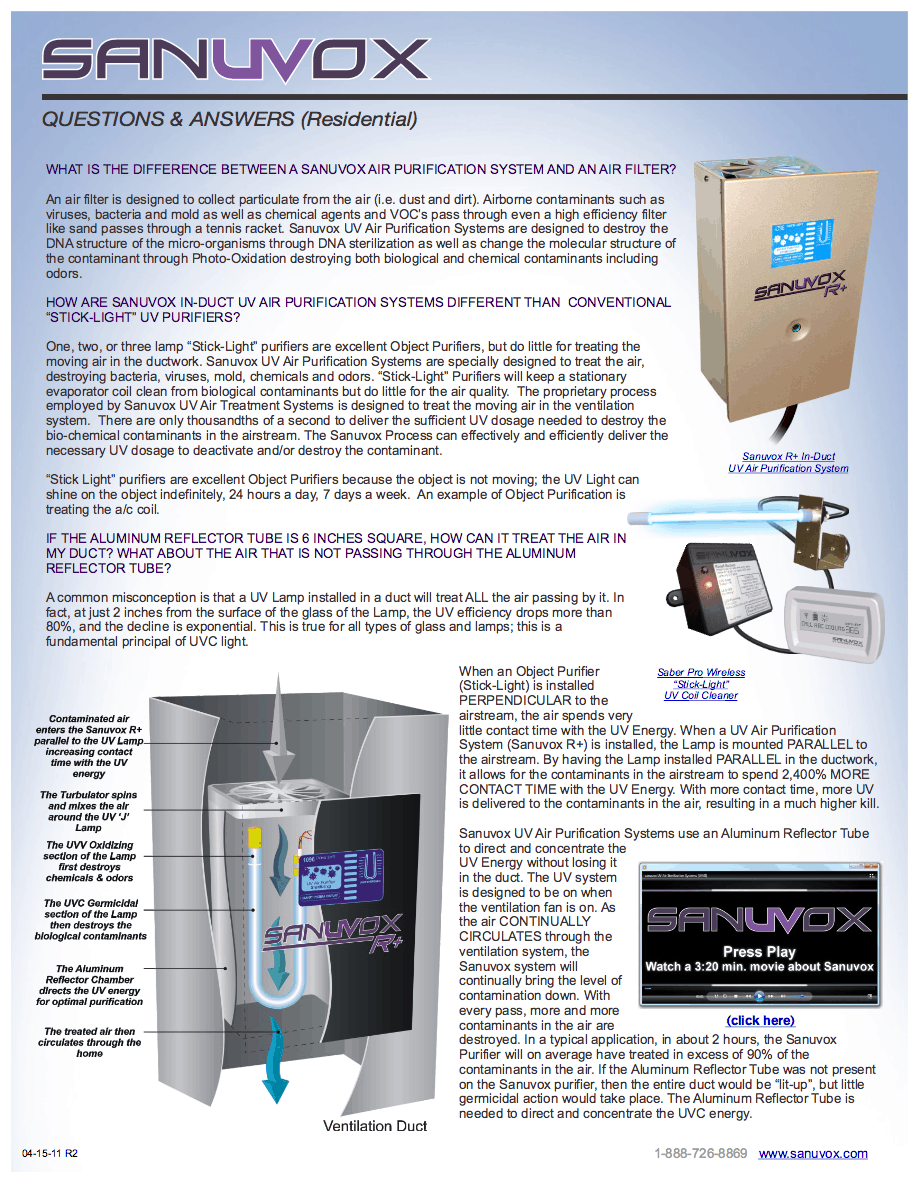
What is UV-C and how does it work? UV-C is short-wavelength ultraviolet light (around 254 nm). It damages the DNA and RNA of micro-organisms so they can no longer reproduce, reducing the load of viable bacteria, viruses and mould. It works physically rather than chemically, so it leaves no residue. What’s the difference between in-duct air disinfection and coil cleaning? They are two different jobs. Air moving through a duct passes the lamps in a fraction of a second, so airstream disinfection needs high UV output and good geometry to deliver enough dose in that brief window. A cooling coil, by contrast, is stationary — so a coil-cleaning system can irradiate it continuously for hours and days, keeping it free of mould and biofilm and maintaining heat-transfer efficiency. The two are often installed together. What is “dwell time” and why does it matter? Dwell time is how long the moving air is exposed to UV as it passes the lamps. Inactivating an organism takes a certain UV dose — intensity multiplied by time — so increasing dwell time (for example, with a parallel lamp installation along the airstream) increases the delivered dose and improves airstream disinfection. Does UV-C disinfect both air and surfaces? Yes, within line of sight and with an adequate dose. Air systems treat the airstream as it passes; surface and coil systems treat what the lamps can directly see. Shadowed areas receive less UV, so lamp placement and system design matter.
Choosing and running a system
How long do UV-C lamps last? As a rule of thumb, germicidal UV-C lamps deliver useful output for around 9,000 hours — roughly 12 months of continuous running. They keep glowing well beyond that, but their germicidal output decays, so they are replaced on a schedule rather than when they stop lighting. We’ll advise the correct replacement interval for the specific lamp you are running. Will UV-C damage my HVAC components? Prolonged UV-C can degrade some plastics, rubber seals and wiring insulation close to the lamps. Sensible system design either shields those components or specifies UV-resistant materials in the irradiated zone. We can advise on protecting nearby components when sizing a system. How is UV-C performance verified? UV-C performance is dose-based and is best confirmed by measurement — calibrated UV-C radiometers for irradiance, and microbiological swab or air sampling for biological reduction. We can arrange or help interpret this kind of testing, as with our viewport safety verification and independent lab reports. Which UV-C system suits my application? It depends on whether you are treating air, surfaces or coils; the size of the space or duct; the airflow; and the environment — healthcare, food processing, cold room, office or home. We supply several brands, including Fresh-Aire UV, sterilAir AG, AIRsteril and Goldensea UV, so we can specify the best fit for the job rather than push a single range. Talk to us with your application and we’ll help specify it. Do you supply outside Australia? We supply and support customers across Australia, New Zealand and the Pacific islands.